Key Takeaways
- A 2.5 cm thyroid nodule sits at the larger end of the scale. Most nodules found on scans are under 1 cm, so 2.5 cm is big enough to deserve proper evaluation.
- Size alone does not decide whether a nodule is dangerous. Ultrasound features, growth rate and biopsy results matter more.
- At 2.5 cm, most international guidelines recommend a fine needle aspiration (FNA) biopsy, whatever the ultrasound appearance.
- The large majority of nodules this size still turn out to be benign.
- See an ENT specialist if you can see or feel the lump, or if you notice swallowing difficulty, pressure or voice changes.
Quick Answer
Yes, a 2.5 cm thyroid nodule is considered large. Most thyroid nodules measure under 1 cm, and nodules above 2 cm carry a higher chance of being cancerous, roughly 15 percent in published studies. A nodule this size warrants an ultrasound assessment and, in most cases, a biopsy.

How Thyroid Nodule Sizes Are Classified
Thyroid nodules are lumps that form within the thyroid gland, the butterfly-shaped gland at the front of your neck. They are extremely common. Studies using high-resolution ultrasound find nodules in up to half of all adults, and most people never know they have one.
Doctors loosely group nodules by their largest diameter on ultrasound:
Size: How it is usually viewed
Under 1 cm: Very common, often found by accident, usually observed
1 to 2 cm: Moderate, biopsy decided by ultrasound appearance
2 to 4 cm: Large, biopsy recommended in most cases
Above 4 cm: Very large, surgery is frequently discussed
A 2.5 cm nodule is roughly the size of a 50-cent coin. At this size it is often visible as a swelling in the neck, especially when you swallow, and can usually be felt with the fingers.
It is worth saying clearly: large does not mean cancerous. Plenty of 2.5 cm nodules are benign colloid nodules or fluid-filled cysts. What size changes is the level of attention the nodule deserves, not the diagnosis itself.
What 2.5 Cm Means For Cancer Risk
Research from the American Thyroid Association community suggests the risk of cancer rises once a nodule passes 2 cm, with studies reporting around 15 percent of nodules above this size proving malignant. Below 2 cm, the figure is lower.
That still means roughly 85 percent of nodules this size are benign. The point of evaluating a 2.5 cm nodule is not to alarm you, it is to sort you confidently into the right group.
Size is also only one input. When assessing your nodule, an ENT specialist weighs:
Ultrasound features
Radiologists grade nodules using the TI-RADS system, which scores features such as whether the nodule is solid or cystic, darker than surrounding tissue, taller than wide, has irregular margins, or contains tiny calcium specks. A smooth, fluid-filled 2.5 cm cyst is far less concerning than a 1.5 cm solid nodule with irregular edges.
Growth over time
A nodule that has been stable for years behaves very differently from one that has grown noticeably within months. Bring any previous scan reports to your consultation, they are genuinely useful.
Your background risk
Family history of thyroid cancer, previous radiation exposure to the neck, and being male or under 30 or over 60 all shift the assessment slightly.
Symptoms A 2.5 Cm Nodule Can Cause
Smaller nodules rarely cause symptoms. At 2.5 cm, some people start to notice:
- A visible lump that moves when swallowing
- A feeling of pressure or fullness in the neck
- Mild difficulty swallowing, especially with dry or bulky food
- A change in voice quality or easy vocal tiredness
- Symptoms of an overactive thyroid if the nodule produces hormone, such as palpitations, heat intolerance or unintended weight loss
Many patients with a 2.5 cm nodule have no symptoms at all and only discover it during a health screening or a scan done for another reason. Absence of symptoms does not remove the need for assessment.
What Tests To Expect
If you have been told you have a 2.5 cm thyroid nodule, the work-up is straightforward and mostly painless.
Thyroid ultrasound
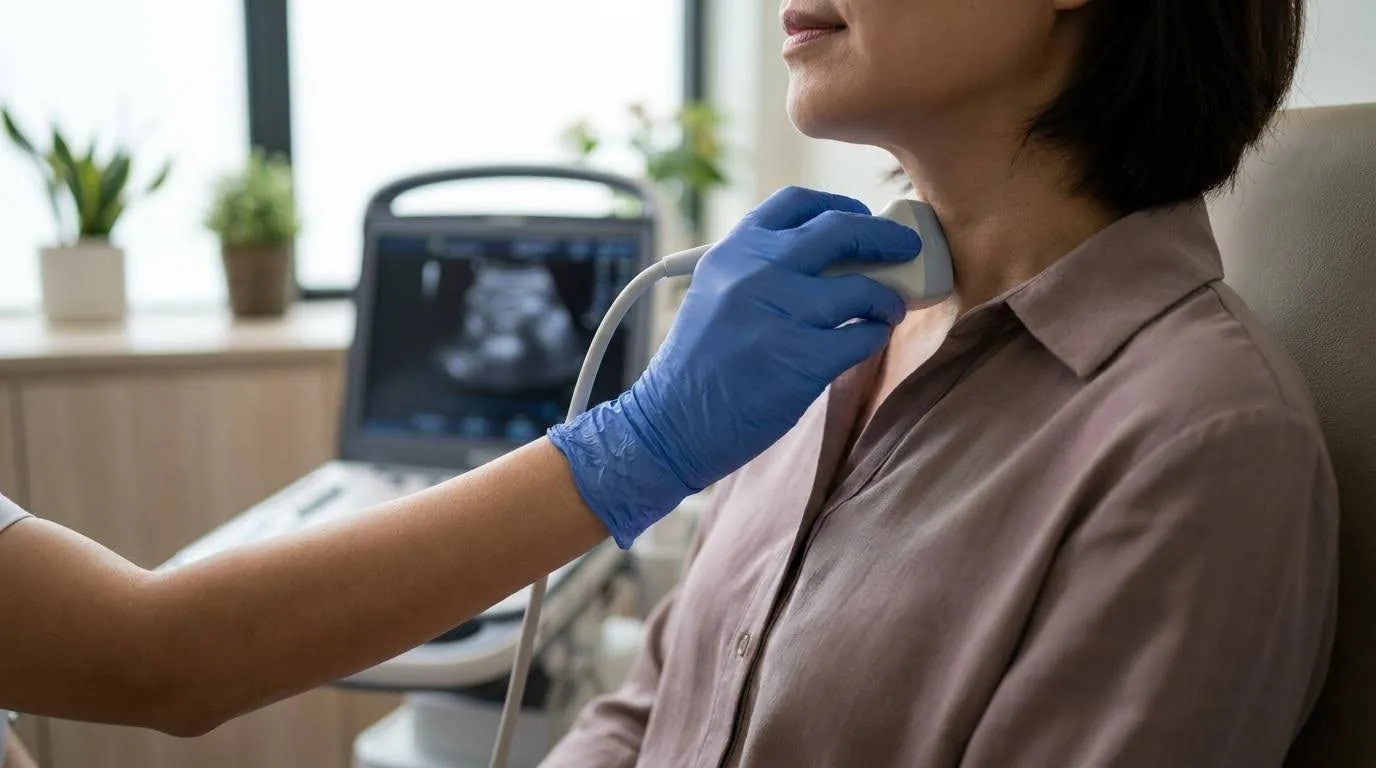
A detailed ultrasound is the first step. It confirms the size, maps any other nodules, and produces the TI-RADS grade that guides everything afterwards. The scan takes around 15 to 20 minutes and involves no radiation.
Blood tests
A thyroid function test checks whether the gland is overactive or underactive. If the thyroid is overactive, a nuclear medicine scan may be added to check whether the nodule itself is producing hormone, because hot nodules are very rarely cancerous.
Fine needle aspiration (FNA) biopsy
For a 2.5 cm nodule, guidelines recommend an FNA biopsy in nearly all cases, even when the ultrasound appearance is reassuring. A very fine needle, thinner than the one used for blood tests, takes a small sample of cells under ultrasound guidance. The procedure takes a few minutes in the clinic and most patients describe it as no worse than a blood draw. Results are reported on the Bethesda scale, which tells your specialist whether the nodule is benign, suspicious or malignant.
Your specialist may also examine your voice box with a thin nasal endoscope if you have voice changes, to check the nerve that runs behind the thyroid.
Treatment Paths Based On Your Results
What happens next depends almost entirely on the biopsy result, not the size alone.
If the nodule is benign: most patients simply return for follow-up ultrasounds, initially every 6 to 12 months. If the nodule is causing pressure symptoms or continues to grow, there are benign thyroid nodule treatment options ranging from continued observation to minimally invasive procedures, and some patients can be managed with thyroid nodule treatment without surgery.
If the result is suspicious or malignant: surgery to remove half or all of the thyroid is usually recommended. Thyroid cancer found at this stage generally has an excellent outlook, and surgery is performed through a small neck crease incision. You can read more about how thyroid operations are planned and performed on our thyroid surgery page.
If the result is indeterminate: a repeat biopsy or a diagnostic operation may be advised, and your specialist will talk you through the reasoning.
Found a lump in your neck or been told you have a thyroid nodule?
Dr Soma provides same-week thyroid assessment, ultrasound review and FNA biopsy at ENT Plus, Paragon Medical Centre Orchard or Parkway East Medical Centre Joo Chiat.
Book an appointment on WhatsApp · Contact the clinic
When To See An ENT Specialist
Make an appointment promptly if:
- You can see or feel a new lump in the front of your neck
- A known nodule has grown, or your scan report mentions growth
- You have swallowing difficulty, persistent pressure, or voice changes
- Your biopsy was indeterminate and you want a second opinion on next steps
A 2.5 cm nodule is exactly the kind of finding that should be assessed properly once, so you either get peace of mind or an early, treatable diagnosis.
Frequently Asked Questions About 2.5 Cm Thyroid Nodules
Can a 2.5 cm thyroid nodule be benign?
Yes, and most are. Around 85 percent of nodules larger than 2 cm prove benign on biopsy. The purpose of evaluation is to confirm this rather than assume it.
Does a 2.5 cm thyroid nodule need surgery?
Not necessarily. Surgery is recommended when the biopsy is suspicious or malignant, or when a benign nodule causes significant pressure symptoms or keeps growing. Many 2.5 cm nodules are simply monitored.
Will a 2.5 cm thyroid nodule go away on its own?
Solid nodules rarely disappear. Cystic nodules can shrink if their fluid is drained, although some refill. Stable benign nodules often stay the same size for years.
Is a thyroid biopsy painful?
Most patients find FNA biopsy only mildly uncomfortable. The needle is very fine, the procedure takes a few minutes, and you can return to normal activities immediately.
How quickly do thyroid nodules grow?
Most benign nodules grow slowly, over years, if at all. Growth of more than a few millimetres within 6 to 12 months is a reason to re-biopsy, which is why follow-up ultrasounds are scheduled.
—
This article is for general information and does not replace a medical consultation. If you have a thyroid nodule, please see a doctor for personalised advice.